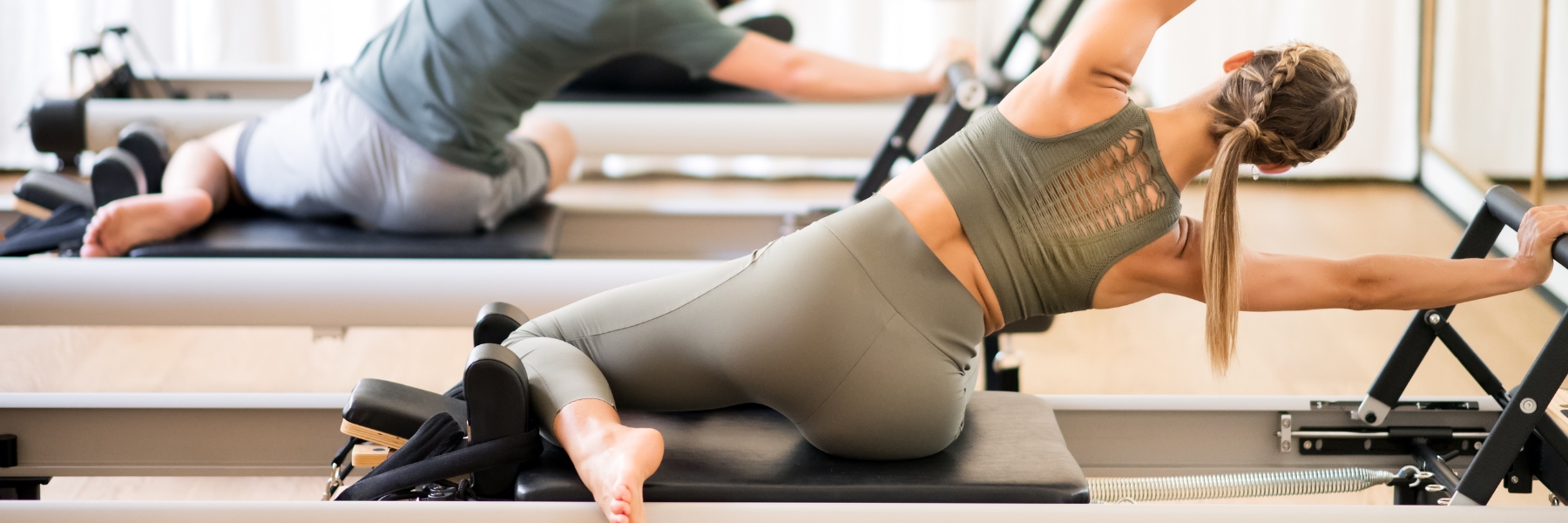
Flexibility & Posture Pilates
For shoulders tired from desk work, shortened chest and hip muscles. A reformer pilates program led by physiotherapists that increases your range of motion while creating tall, balanced posture.
For shoulders tired from desk work, shortened chest and hip muscles. A reformer pilates program led by physiotherapists that increases your range of motion while creating tall, balanced posture.
Modern life forces our bodies into the same position for hours: forward spinal curve at the desk, head toward the screen, shortened chest muscles, tight lower back. Over time, this posture becomes chronic tension, headaches, and spinal discomfort.
Flexibility and posture pilates is a program designed to address this modern physical strain. The goal isn't just to become more flexible; it's to achieve a tall, balanced, and functional posture.
Unlike classical stretching, pilates is based on muscles working under controlled lengthening. This provides not just flexibility gains, but also the ability to control muscles. The reformer's spring resistance system allows you to safely expand joint range of motion within controlled limits.
Posture correction gives you access to your actual height—upright posture in the mirror.
Functional mobility gains in hips, shoulders, and spine.
Lasting looseness in the neck, shoulders, and lower back areas.
As cervical posture improves, tension-type headaches notably decrease.
Ability to notice your posture and correct it throughout the day.
A more flexible and balanced body is less susceptible to injury in daily life.
Initial consultation including static posture analysis, joint range of motion measurements, and muscle shortness tests.
Personalized exercise selection based on lengthening tight muscles and strengthening weak muscles.
Reassessment every 4 weeks; gains are safely advanced to higher levels.
Yes. Pilates uses the principle of controlled lengthening (eccentric loading) rather than static stretching, allowing muscles to both strengthen and lengthen. Regular pilates practitioners see visible increases in range of motion in the hips, hamstrings, shoulders, and chest.
Yes, very much so. Prolonged sitting causes chest muscles to shorten and back muscles to weaken, leading to forward shoulder rounding. FiT48's posture program targets this muscle imbalance: lengthens tight muscles and strengthens weak ones.
Postural kyphosis (muscle-related hunchback) can be greatly corrected with regular pilates. For structural kyphosis (bone-related), it helps slow progression and improves appearance. Our physiotherapist will assess which type you have.
Both contribute to flexibility. Yoga relies on static holds while pilates combines dynamic control and strength with flexibility gains. For posture correction, pilates' ability to convert strength into flexibility is more effective.
Members doing regular pilates (2 sessions per week) see measurable increases in range of motion within 4 weeks. An 8–12 week program is recommended for postural changes.
Book your free trial session; let's assess your posture together.
Message on WhatsApp